It supports the resilience and commercial success of our business which, in today’s world, includes, amongst other things, managing the growing risks from deforestation. That means we also need to support our clients’ ability to do the same; their long-term resilience underpins our resilience. Through how we manage our business and work with our clients, we also can make a positive contribution to society’s efforts to halting deforestation and ecosystem conversion. This is essential to protect biodiversity, mitigating climate change, and upholding human rights. Forests are not only vital carbon sinks but also home to indigenous communities whose livelihoods and cultures depend on them.
Forest coverage is rapidly declining as a result of human activities, including agricultural expansion, urbanisation, fires and logging. Between 2015 and 2020, deforestation was estimated at approximately ten million hectares per year1. Agricultural expansion remains the primary driver of deforestation and forest degradation, resulting in significant losses of forest biodiversity. With the world population now having passed the eight billion mark, the challenges to feed the world and at the same time protect the planet’s forests will increase.
Our Environmental and Social Risk (ESR) framework sets standards for the due diligence we perform, including for clients active in the agriculture commodities sector. Some of those standards include asking clients whether they comply with certain programmes and/or certifications. At the bottom of this page are examples of the programmes and certificates we consider to be relevant to the agricultural commodities sector (this list is non-exhaustive).
We recognise the importance of preserving High Conservation Value ecosystems that serve as critical carbon sinks. As per our ESR Framework, timber from illegal logging operations, deforestation and/or burning down tropical rainforest, and removal of primary or High Conservation Value (HCV) forests fall under restricted activities for financing.
Our deforestation approach
At ING, deforestation is addressed as part of the bank’s broader environmental, social and governance (ESG) risk management framework whereby deforestation‑related risks are identified, assessed and managed through existing risk‑based processes. To further strengthen these processes and address identified information gaps, ING has implemented a targeted assessment and engagement approach to deforestation (i.e., our deforestation approach), providing enhanced insights and supporting more effective engagement.
As per our deforestation approach, we engage in a risk-based manner with clients active in high-risk commodities i.e., cattle, palm oil, soy, cocoa, or coffee. We assess whether these clients have put in place no-deforestation and no-ecosystem conversion commitments. We support them to put in place actions and targets towards full traceability2 in their supply chains, with the aim of removing deforestation risks from their production and value chain. The commodities in scope are based on guidance from the EU Regulation on Deforestation-free products and our existing exposure to these commodities. Wood and natural rubber are exceptions and will continue to be assessed under standard ESR screening due to ING’s limited exposure to these commodities. Our deforestation approach has three steps: 1. scoping our clients, 2. Assessment criteria, and 3. client engagement, each step is described in more detail below.
Our approach to addressing the risks of deforestation is guided by globally recognised definitions of ‘deforestation’ and ‘ecosystem conversion’ as outlined by the Accountability Framework initiative (AFi), the World Wide Fund for Nature (WWF), and the United Nations Environment Programme (UNEP). Our Deforestation approach complements the due diligence measures outlined in our Environmental and Social Risk (ESR) Framework.
Scoping criteria
Our scoping criteria have remained the same as set out in the 2024 update on deforestation and ecosystem conversion. It is a risk-based approach with a focus on global Wholesale Banking Commodity, Food & Agriculture sector clients.3
We apply a two-step approach, beginning with defined criteria to filter our client base for those operating in the food and agriculture value chains and most directly involved with high-risk commodities and high-risk regions (see commodity/ country matrix applied below).
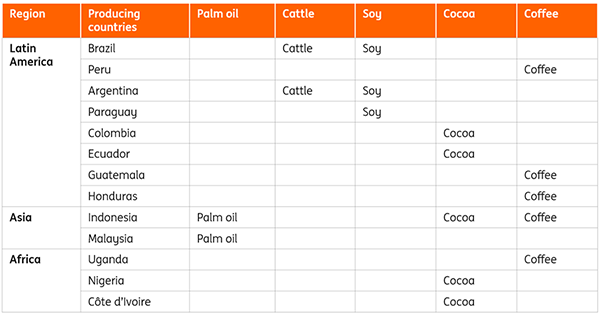
The second step is to narrow down clients involved with primary production, trading, or first-time processing of high-risk commodities. Under this step, we also evaluate the share of our client’s revenue and procurement spend linked to the high-risk commodity, against a set threshold. Based on the results of these two-steps, we arrive at the in-scope clients for our deforestation and ecosystem conversion approach.
Assessment criteria
The in-scope clients are assessed based on the criteria shown under figure 1 which captures ING’s assessment approach. See below a schematic view of ING’s assessment approach to address deforestation and ecosystem conversion
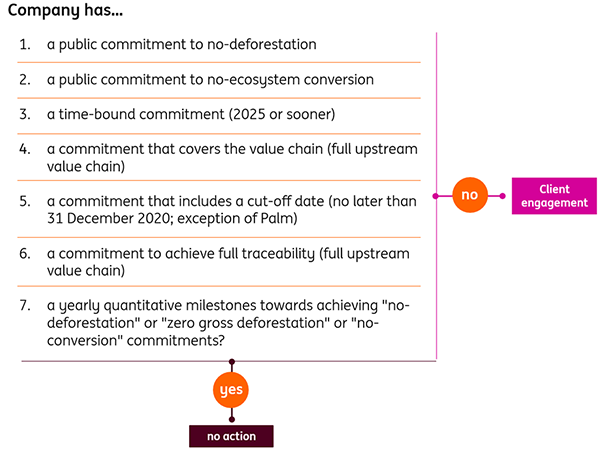
In line with the Accountability Framework initiative (AFi) and Science Based Targets Network (SBTN) guidance, our approach requires a target date4 of no later than 2025. We actively monitor progress and engage with clients to seek adherence to this timeline. For cut-off dates5, we apply the EU Deforestation Regulation (EUDR) standard of 31 December 2020 for key commodities, including cattle, soy, cocoa, and coffee. This seeks to reduce the risk that products do not originate from land deforested after this date. For palm oil, we follow the Roundtable on Sustainable Palm Oil (RSPO) standard, which uses an earlier cut-off date of November 2005, reflecting this long-standing benchmark, and is aligned with ING’s Environmental and Social Risk (ESR) Framework. Additionally, we consider relevant country-specific regulations on cut-off dates where applicable, to support a globally aligned and context-sensitive deforestation approach.
In 2025, we introduced distinct enhancements to strengthen our assessment criteria. These include:
- Incorporating milestone-related questions (see table) based on updated guidance from the Accountability Framework initiative (AFi). This enhancement is not assessed for the current cycle—since the data reflects 2024 reporting period, and the AFi’s milestone requirement is applicable from 2025 onwards.
- Separating deforestation and ecosystem conversion commitments in our assessment criteria. This change improves the granularity and accuracy of our internal scoring methodology, allowing us to better capture the distinct nature of these issues and track client progress more effectively.
Engagement
We aim to engage with in-scope Wholesale Banking clients under this approach to understand their current position in addressing deforestation and ecosystem conversion, the challenges they face, and the support they may require from us in our role as a financier.
We monitor client progress towards alignment with ING’s deforestation assessment criteria (refer Figure 1). Where gaps or risks are identified, we may encourage clients to strengthen their commitments and/or disclosures.
Aiming for full traceability is one of our key engagement criteria. Full traceability helps to verify whether and where adverse impacts may occur. We recognise that not all our clients currently have full traceability within their supply chains. We therefore plan to engage with our clients in the manner set out above, to discuss where they stand and what their commitment is with respect to traceability.
These engagements go beyond compliance, enabling meaningful collaboration and tailored financing solutions such as sustainability‑linked loans (SLLs) with customised KPIs. Examples of such KPIs include: improving commodity traceability to the origin, mapping and monitoring suppliers for deforestation risk, supporting deforestation-free supply chain, increasing sourcing of products with no deforestation risk, using recognized external certifications (e.g., Rainforest Alliance/UTZ, Fairtrade), and introduction of regenerative agriculture principles such as agroforestry.
This engagement approach does not replace existing (sometimes stricter) requirements already included in the ESR Framework. For instance, our regular ESR screening of high-risk clients includes a check on adverse impacts. If research or third parties indicate clients might be linked to deforestation, we verify this information with the client. This may lead to further engagement with our clients to understand if actual adverse impacts are taking place and which actions our clients are taking to address these impacts. If engagement on these adverse impacts is not possible or unsuccessful, we may consider several client-level actions, as part of our broader financial risk assessment on an individual, and an objective basis.
Current & planned improvements
At ING, we have voluntarily initiated the mapping of high-risk commodities and related clients. Given the evolving regulatory landscape, this approach may be further refined over time.
Instead of having separate publications on this topic, we now combine and focus relevant information and updates on this page. By disclosing this in one spot, ING aims to be transparent in our approach and engagement.
Looking ahead, we aim to further develop and, where possible, further integrate our deforestation methodology into systems and processes. Our objective is to integrate this approach into our broader ESG (environmental, social and governance) risk assessment framework, enabling consistent application across the bank. Through this integration, we aim to combine our existing, largely manual deforestation approach with a more automated and streamlined ESG risk framework. This evolution will strengthen the robustness of our assessments, and continuing to enable informed and meaningful client engagement supported by strong data insights.
Notes
This document discusses one or more specific transactions and/or contains general statements about ING’s climate approach. The approach and criteria referred to in this document are intended to be applied in accordance with applicable law. Due to the fact that there may be different or even conflicting laws, the approach, criteria or the application thereof, could be different.
1Data from the Food and Agriculture Organization of the United Nations (FAO)
2Traceability refers to the ability to track and verify the origin of materials and their movement across the supply chain, supporting transparent and accountable sourcing.
3Clients include global Wholesale Banking lending and financial markets clients of ING Bank N.V.
4The target date refers to the deadline by which a company (or other entity setting commitments or policies) is expected to fully implement and comply with its deforestation-related commitments
5The cutoff date is a specific moment in time. If any forest is cleared or natural land is converted after that date, the products from that area no longer meet “no deforestation” or “no conversion” rules. This is important because it sets a clear line for sustainable sourcing.
Examples of programmes and certificates relevant to the agricultural commodities sector:
| Commodity | Programmes/certificates |
|---|---|
| Soy | |
| Cotton | |
| Coffee, tea, cocoa, sugar | |
| Wood | |
| Palm oil |
Page updated: 7 July 2026.