They address the global challenges we face, such as poverty, inequality, climate change, environmental degradation, prosperity, and peace and justice.
This was the first time that the private sector (i.e. everything other than governments) had been called on to play a key role in achieving the global development agenda. It goes beyond charity. It’s about exploring new business opportunities and defining new ways of doing business that align economic growth with positive environmental and social impact. Seizing such opportunities will require innovation and an enhanced approach to partnerships.
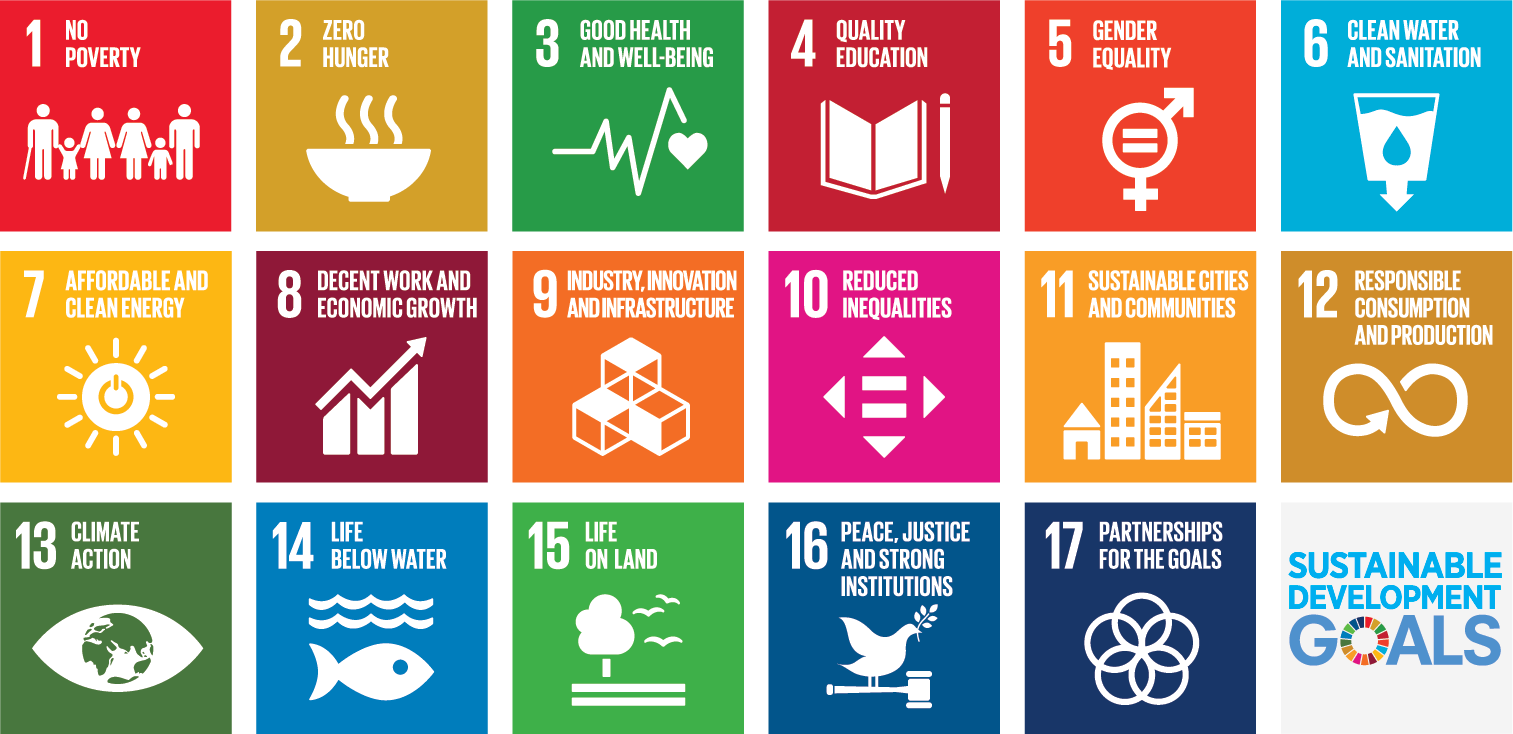
SDG1 No poverty | End poverty in all its forms everywhere.
SDG2 Zero hunger | End hunger, achieve food security, improve nutrition, and promote sustainable agriculture.
SDG3 Good health and well-being | Ensure healthy lives and promote well-being for all at all ages.
SDG4 Quality education | Ensure inclusive and equitable quality education and promote lifelong learning opportunities for all.
SDG5 Gender equality | Achieve gender equality and empower all women and girls.
SDG6 Clean water and sanitation | Ensure availability and sustainable management of water and sanitation for all.
SDG7 Affordable and clean energy | Ensure access to affordable, reliable, sustainable, and modern energy for all.
SDG8 Decent work and economic health | Promote sustained, inclusive, and sustainable economic growth, full and productive employment, and decent work for all.
SDG9 Industry, innovation and infrastructure | Build resilient infrastructure, promote inclusive and sustainable industrialization, and foster innovation.
SDG10 Reduced inequalities | Reduce inequality within and among countries.
SDG11 Sustainable cities and communities | Make cities and human settlements inclusive, safe, resilient, and sustainable.
SDG12 Responsible consumption and production | Ensure sustainable consumption and production patterns.
SDG13 Climate action | Take urgent action to combat climate change and its impacts.
SDG14 Life below water | Conserve and sustainably use the oceans, seas, and marine resources.
SDG15 Life on land | Protect, restore, and promote sustainable use of terrestrial ecosystems, forests, and biodiversity.
SDG16 Peace, justice and strong institutions | Promote peaceful and inclusive societies, provide access to justice for all, and build effective, accountable institutions.
SDG17 Partnerships for the goals | Strengthen global partnerships to support and achieve the SDGs.
Our strategic focus
As a large bank serving customers in over 40 countries, we contribute directly and indirectly to virtually all SDGs through the clients and projects we finance. We choose to focus on the SDGs that we can impact the most, using our business strategy and purpose to guide us.
Through our approach to sustainability in the areas of climate action, financial health and human rights, and through the customers and projects we finance, we believe that we make the biggest contribution to the following SDGs: decent work and economic growth (goal 8), reduced inequalities (goal 10), responsible consumption and production (goal 12) and climate action (goal 13). See more about these specific goals below.
In doing so, we work with other financial institutions, multinational enterprises and industry organisations to advance our understanding of the SDGs and seize impact opportunities.
ING is a signatory to the UN Environment Programme Finance Initiative (UNEP FI) Principles for Responsible Banking (PRB). PRB is a sustainable banking framework through which signatory banks take action to align their core strategy, decision-making, lending and investment with the Sustainable Development Goals, as well as international agreements such as the Paris Climate Agreement.
SDG 8: Decent work and economic growth
 This goal is about inclusive and sustainable economic growth. Banks play a key part here because of their intermediary role in the global economy. The goal involves increasing work opportunities, especially for young people, and protecting people’s labour rights, for example.
In terms of sustainable economic growth, we have a hard stance against certain activities that we don't finance - see our stances. Then there are clients and projects that we finance only after certain environmental and social standards are met. Read more about our environmental and social risk approach. We’re also guided in our business operations and engagements with clients, customers and suppliers by established norms and best practice standards such as the UN Guiding Principles on Business and Human Rights, the OECD Guidelines for Multinational Enterprises on Responsible Business Conduct, and the International Finance Corporation (IFC) Performance Standards, where applicable. Read more about our approach to human rights.
Besides mitigating harm, we also seek ways to make positive contributions to SDG 8. We pursue sustainable innovation through technology and new business models. We also aim to contribute to climate action and financial health.
We believe financially healthy people contribute to a healthy economy and help drive social progress. We aim to make an impact on improving financial health behaviour by helping people manage their everyday finances and helping them plan for the future, while being an accessible bank for everyone. We align our efforts with the United Nations and a group of other banks to help set the standard for financial health impact for our industry. In December 2021 we became one of the founding signatories of the United Nations’ Principles for Responsible Banking’s Commitment to Financial Health and Inclusion. Read more about our approach to financial health.
We also use our expertise to create a positive impact in our communities. Our community investment approach supports programmes that contribute to an inclusive economy, aiming to empower three million people to gain better access to the economy by 2025.
SDG 10: Reduced inequalities
 This goal is about ensuring that no one is left behind in the chance for a better life. As ING, we believe that we can make an impact by helping to improve the financial health of our customers and the people in the communities we operate in. We aim to drive social progress by striving to create equal opportunities and making sure our products, services and facilities are accessible in a way that best fits different customer needs and abilities.
We regularly determine the specific financial health challenges in our local markets and aim to address these in each country. Our community investment approach supports local programmes that contribute to an inclusive economy. We support projects in three areas: future-proof employment, financial capabilities and social enterprises.
In our financial health ambition, we take vulnerabilities and consumer protection into account. In that sense there is a clear link with human rights. We believe that every person everywhere has the right to be treated with dignity and have their interests considered equally. Our environmental and social risk framework (ESR) includes an overarching policy on human rights to guide us when assessing the clients and transactions we finance.
SDG 12: Responsible consumption and production
 This goal is about preventing the degradation of environmental resources. It includes policies that improve resource efficiency, reduce waste and make sustainability practices mainstream.
ING is committed to better understanding the impact of our lending activities and to work with clients to drive sustainable progress.
We aim to drive responsible consumption and production through our sustainable lending activities. We strive to work with companies whose activities consider people, society and the environment, and we also work with our clients to finance and facilitate their transition to low-carbon technologies. See our ESR policy and our sustainability section.
SDG 13: Climate action
 This goals is about climate action. Our climate ambition is to play a leading role in accelerating the low carbon transition. We’re stepping up action on climate because it matters to the bank, our customers and society.
We need to ensure the resilience and commercial success of our business which, in today’s world, includes managing the risks that are escalating with global warming. And with the global transition now underway, financing the new technologies, infrastructure and business models of the future economy presents a growing opportunity for us.
As a bank, the biggest impact we can make is through our financing. We’re focused on three areas for action:
- To drive down emissions, our greatest opportunity to accelerate progress is through working with our large clients on their transitions to net zero emissions.
- To build up a sustainable future, we’re stepping up our financing for innovative technologies and solutions needed for a low carbon world.
- To include everyone in the low carbon transition, we want to find new ways to enable people to stay a step ahead on climate.
Read more about our approach to climate action.