Forty years ago, today (13 February), the Netherlands took its first step into the era of digital banking when Postbank, ING’s predecessor, introduced Girotel, a groundbreaking service that enabled customers to manage their finances from home using a computer.
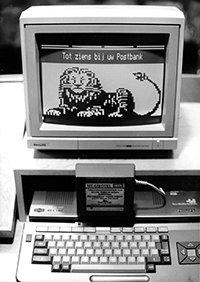 At a time when banking still relied heavily on paper forms and postal delivery, Girotel represented a radical shift in convenience, speed and customer empowerment.
Up until 1986, consumers had to rely on paper transfer forms and the post. Girotel made it possible for customers to do their banking from home entirely from their computer. This made Girotel one of the very first digital financial services in Europe.
The system was built on the technical foundations laid down by Postgiro in the early 1980s, following experiments with new technologies such as networks, cryptography and Viditel systems.
Ahead of its time
Bob Timmerman, head of Digital Banking at ING in the Netherlands said Girotel was far ahead of its time.
“The move from paper transfers to digital assignments from home was a huge leap in customer convenience and reliability."
“It put the Netherlands on the map as a digital fintech pioneer, long before the word 'fintech' even existed,” said Bob.
An offline version, introduced to reduce dial‑up telephone costs, accelerated adoption and demonstrated the bank’s early commitment to customer‑centric innovation.
New standards for security
Girotel also set new standards for security with its combination of personal codes and TAN verification, principles that still underpin modern authentication.
Although Girotel was phased out when internet banking took over in the 2000s, its legacy lives on. It laid the foundation for the digital payment ecosystem customers now use every day.